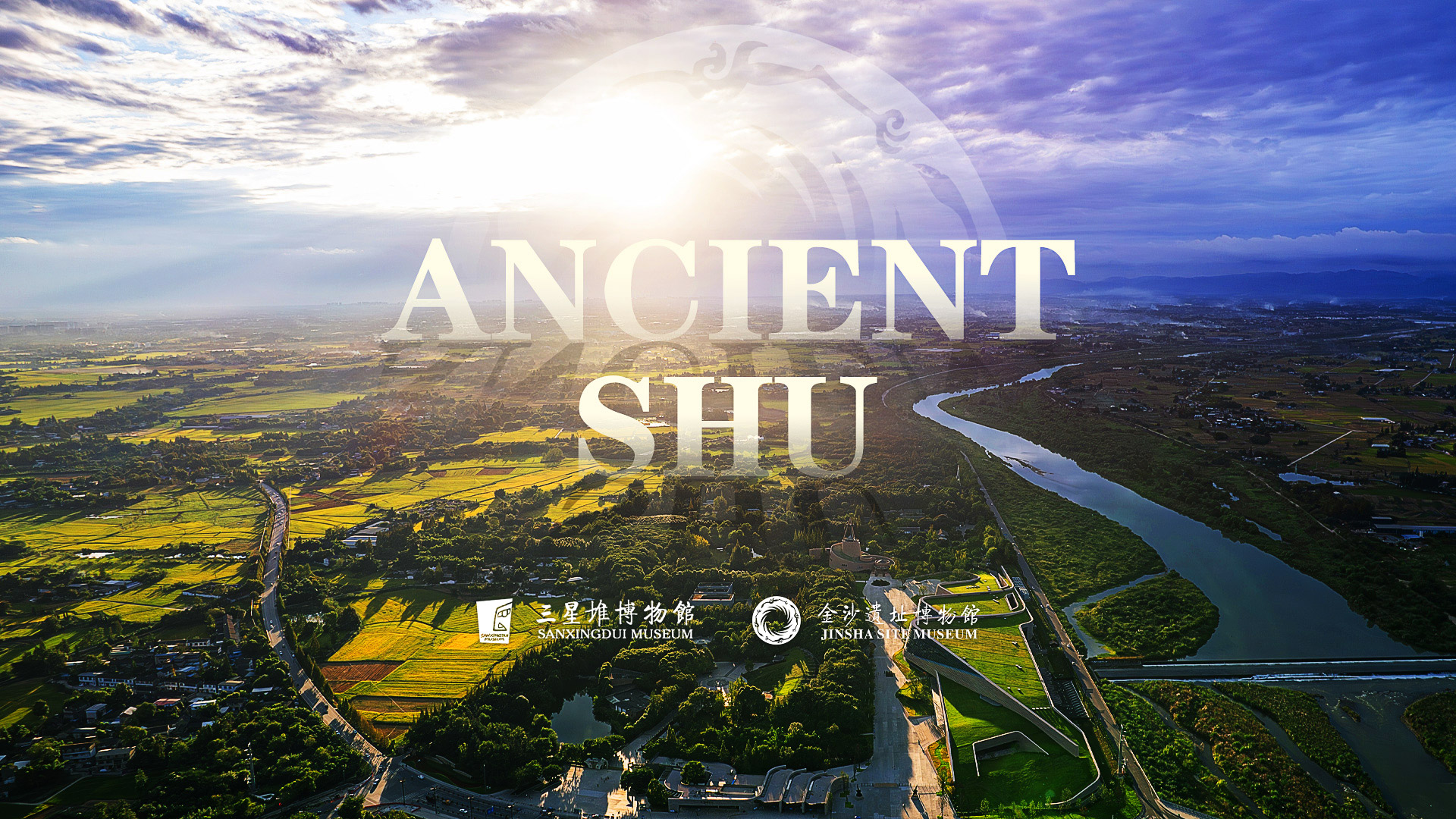
Sanxingdui and Jinsha form the core site complex of an early regional state—the ancient Shu kingdom—established by its people on the Chengdu Plain. Together, they represent the pinnacle of the Bronze Age achievement in the upper Yangtze River region of China, serving as tangible testament to the historical accounts of the ancient Shu kingdom in Chinese records. Spanning thousands of years, the ancient Shu civilization has left behind a remarkable array of precious artifacts, including gold, bronze, jade, stone, and ivory. These relics illuminate a society with distinct theocratic beliefs, profound cosmological views, masterful craftmanship, and the evolving trajectory of its social development.
Core Carrier of Theocratic Beliefs
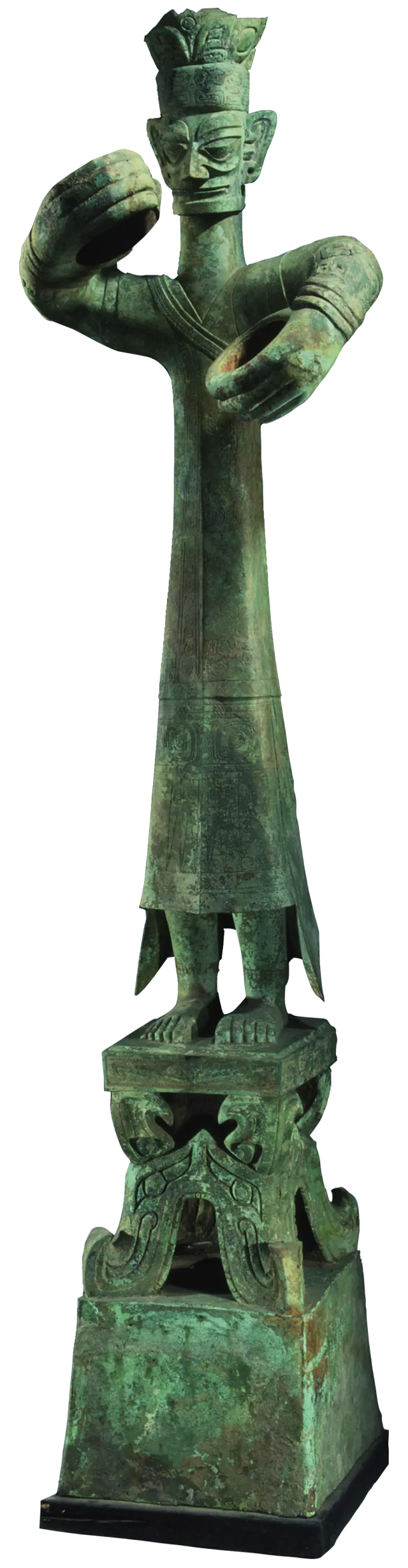
The bronze civilization of Sanxingdui represents the most extraordinary chapter in the history of ancient Shu. During the late Shang Dynasty (3000–3200 years ago), the ancient Shu people brought bronze casting to the technological zenith of their time. These monumental, strikingly unique bronzes were not mere utilitarian objects, but rather ritual implements—crafted specifically for communing with heaven, earth, and the spirits. As such, they stand as a powerful testament to the deep intertwining of theocratic authority and royal power in ancient Shu. Unearthed in concentrated clusters from the sacrificial pits, artifacts such as the bronze standing figure, sacred trees, and masks were deliberately buried with meticulous care. They embody the ancient Shu people’s profound reverence for the cosmos and the spiritual realm, while simultaneously bearing witness to the kingdom’s sophisticated social organization and belief system. Today, these remarkable objects serve as the key to deciphering the nature of ancient Shu’s theocratic society.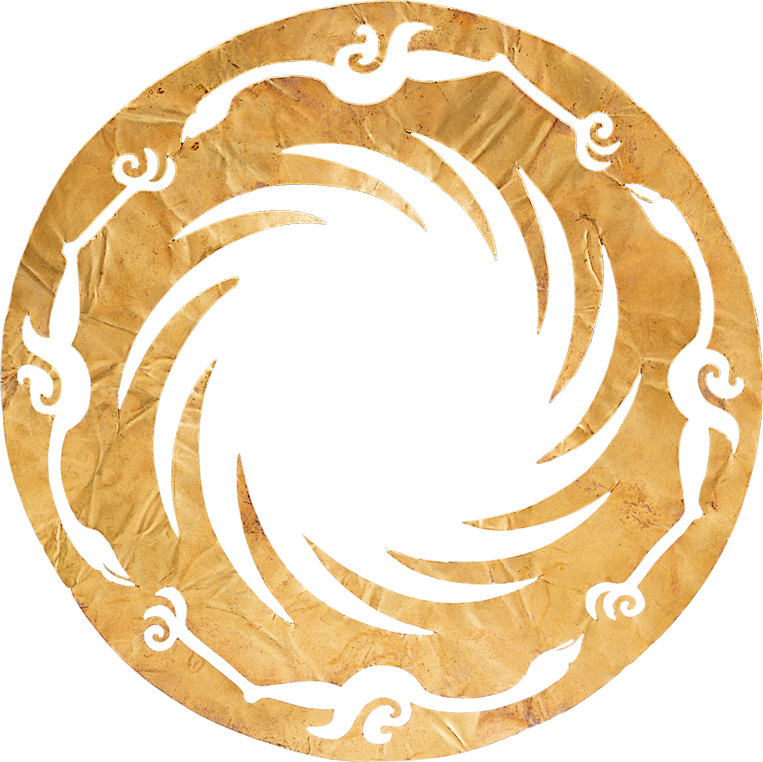
Symbolic Code of Royal Authority and Hierarchy
The gold craftsmanship of the ancient Shu civilization stands in a class of its own. At Sanxingdui and Jinsha, artisans employed masterful techniques—hammering, chiseling, gilding—to create objects, whose intricate motifs embody the royal authority and spiritual beliefs of the ancient Shu kingdom. Unearthed in 1986 from the Sanxingdui sacrificial pits, the gold scepter served as the definitive insignia of ancient Shu kingship. Over a decade later, the Sun and Immortal Birds Gold Ornament, discovered at Jinsha in 2001, still gleamed brilliantly after three millennia—today, it endures as the emblem of China’s cultural heritage. Ancient Shu goldware was never merely decorative but deeply tied to ritual sacrifice and dynastic succession. The fish-bird-arrow motifs on the gold scepter and the fish-shooting pattern on the gold crown band subtly echo the legend of the Yufu dynasty. Meanwhile, the swirling pattern of the Sun and Immortal Birds carries the ancient Shu people’s sun worship More than exquisite artifact, each piece of gold objects serves as a code of power and a totem of belief—engraved in gold by the ancient Shu people.
Medium for Communicating with Heaven and Earth
In ancient Shu civilization, jade served as the principal ritual medium connecting the human realm and the divine. From the early jade ornaments of the Baodun culture to the zhang blades, bi discs, and cong tubes of Sanxingdui and Jinsha, the veneration of jade endured as a defining thread throughout the arc of Shu civilization. Most of the raw jade material was sourced from distant lands and was finely carved into objects of profound ceremonial significance, playing a vital role in rites dedicated to heaven, earth, and ancestors. The ten-section jade cong tube unearthed at Jinsha shares an unbroken lineage with those of the Liangzhu culture, witnessing the interaction between ancient Shu civilization and the middle and lower Yangtze River region. Meanwhile, the zhang blades from Sanxingdui—remarkably diverse in form—were the most widely used jade objects in ancient Shu ritual practice. For the ancient Shu people, jade was the material of reverence. Upon its lustrous, tactile surface, they inscribed their awe of the cosmos and their supplications to the spirits, transforming jade into the most exquisite medium for dialogue between heaven and earth.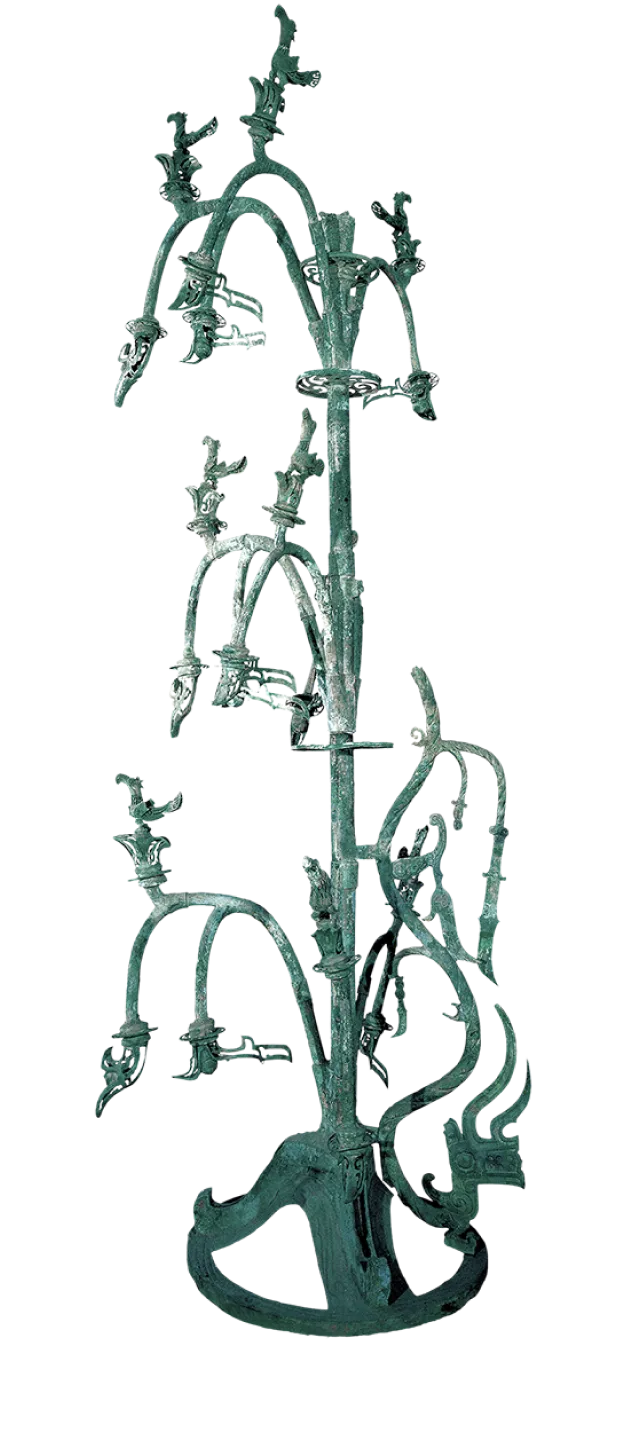
Poetic Expression of Cosmic View
In ancient Chinese mythology, the Golden Crow carries the sun on its back. The ancient Shu people gave tangible form to this romantic imagination of the sun and the cosmos, casting bronze sacred trees and solar totems that encode their understanding of cosmic orders, thus yielding a distinctive expression of cosmic view. The bronze sacred tree of Sanxingdui rises to a height of nearly four meters. Adorned with lush branches, perched golden crows, and winding dragons and snakes, it was regarded by the ancient Shu people as the “axis of the universe” connecting heaven, earth, and humanity. At Jinsha, the Sun and Immortal Birds Gold Ornament tells a complementary story. With its twelve radiant solar rays and four soaring birds, it perfectly distills the ancient Shu people’s understanding of the solar cycle and the rhythm of the turning seasons. From Sanxingdui to Jinsha, the sacred tree and sun totem share a single spiritual lineage. More than mere artifacts, they are projections of the ancient Shu people’s cosmic understanding, reflecting the reverence and exploration of natural forces by the early inhabitants of the upper Yangtze River region.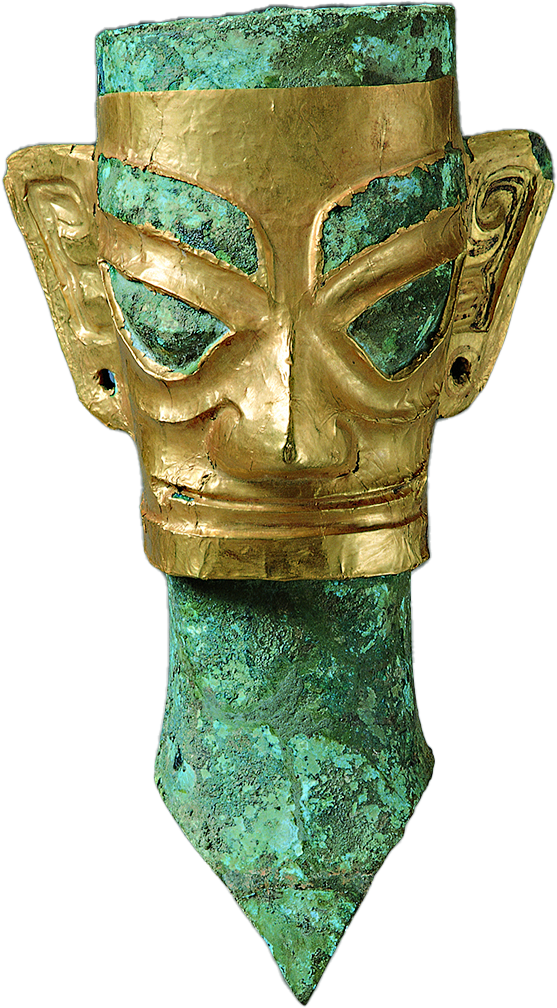
Multidimensional Dialogue of the Belief System
The belief world of the ancient Shu people was characterized by a multifaceted dialogue between humans and deities. They held that these realms were not irrevocably separated, but could commute through the mediation of shamans (wu and xi), ultimately achieving a unity between humans and deities. The sculptures and ritual objects from Sanxingdui and Jinsha offer a vivid material testament to this worldview. The bronze standing figure represents the shaman bridging with heaven and earth, the bronze masks give concrete form to deities and ancestors, and the gold scepter and gold masks serve as the insignia through which shamans exercise divine authority. From the bronze mask with protruding eyes at Sanxingdui to the gold masks at Jinsha, and from the bronze human heads to the stone kneeling figurines, the ancient Shu people employed these formal distinctions to delineate the identities of human, shaman, and deity through the contrasts in the sculptures, yet bound these three realms together through sacrificial rituals. Positioned at the very nexus of politics and ceremony, the shaman functioned as the essential mediating link. Under their auspices, the ancient Shu belief system coalesced into an integrated whole, a world where royal power intertwined with theocratic authority, where humankind stood in dialogue with nature, and where mortals reached across the threshold to the spirits.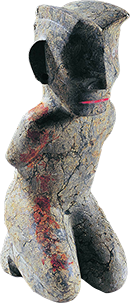
Symbiosis of Resources and Beliefs
The land of ancient Shu abounded in natural resources—ivory, jade, stone, and more. These not only sustained the material foundations of survival and development, but also served as carriers of their spiritual belief, woven deeply into the fabric of sacrificial rituals and daily life. At Sanxingdui and Jinsha, hundreds of intact ivory tusks have been brought to light. Acquired largely through interregional exchange, they stand as emblems of the ancient Shu people’s capacity to marshal and command resources. The stone tiger and stone kneeling figurine from Jinsha, vividly rendered, offer a tangible window into the sacrificial and offering culture that permeated in ancient Shu ritual practice. In awe of nature yet adept in its utilization, the ancient Shu people transformed natural resources into symbols of belief. In their hands, each remnant of the natural world became a nexus linking the material and the spiritual and an enduring testament to the dynamic exchange of resources and cultural convergence between ancient Shu realm and its surrounding regions.
Civilization Relay from Baodun to Jinsha
The development of ancient Shu civilization unfolded a relay of urban settlements cross millennia. The Baodun culture (3700–4500 years ago) built the earliest prehistoric walled settlements on the Chengdu Plain. Then Sanxingdui emerged as the preeminent capital of the ancient Shu kingdom, creating a spectacular bronze civilization. Around 1100 BCE, Jinsha took up the torch, becoming the new political and cultural center of the ancient Shu while preserving and advancing its foundational beliefs and craftsmanship. From the defensive system of “city wall and moat” and prehistoric settlement layout of Baodun, to the fully articulated capital layout of Sanxingdui—comprising a palace area, a dedicated craft production zone, and large-scale ritual architecture—and onward to the systematic planning of Jinsha with its palace complex, residential quarters, and workshop districts, the evolution of ancient Shu cities reflects not only advances in architectural technology but also the very social fabric and trajectory of ancient Shu civilization itself. In its entirety, this urban sequence traces a clear arc, from its inception to its peak, and from city-states to capital cities.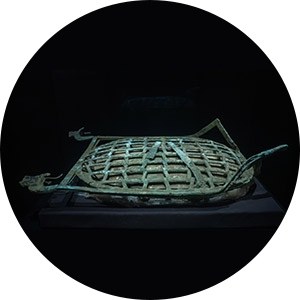
Mastery of Craft and Art
The brilliance of ancient Shu civilization is inseparable from the ultimate spirit of craftsmanship embodied by its people. From the “core rod and strip chaplets” technique in bronze casting, to the hammering and chiseling of gold, and the meticulous carving of jade, the ancient Shu people pushed early handicraft technology to its peak. The casting of the Sanxingdui bronze sacred tree employed a unique technique of “core rod and strip chaplets”, allowing massive bronze components to be formed with astonishing precision. The Sun and Immortal Birds Gold Ornament from Jinsha, a mere 0.02 cm in thickness, bears intricate incised patterns of breathtaking complexity. Jade processing demanded a rigorous sequence of cutting, carving, grinding, and polishing. These achievements represent far more than mere technical skill; they are the embodiment of art itself. The ancient Shu people infused every tool and finished object with creativity and wisdom, making the spirit of craftsmanship a driving force in the transmission of civilization and bequeathing a precious technological legacy for the broader development of ancient Chinese handicrafts.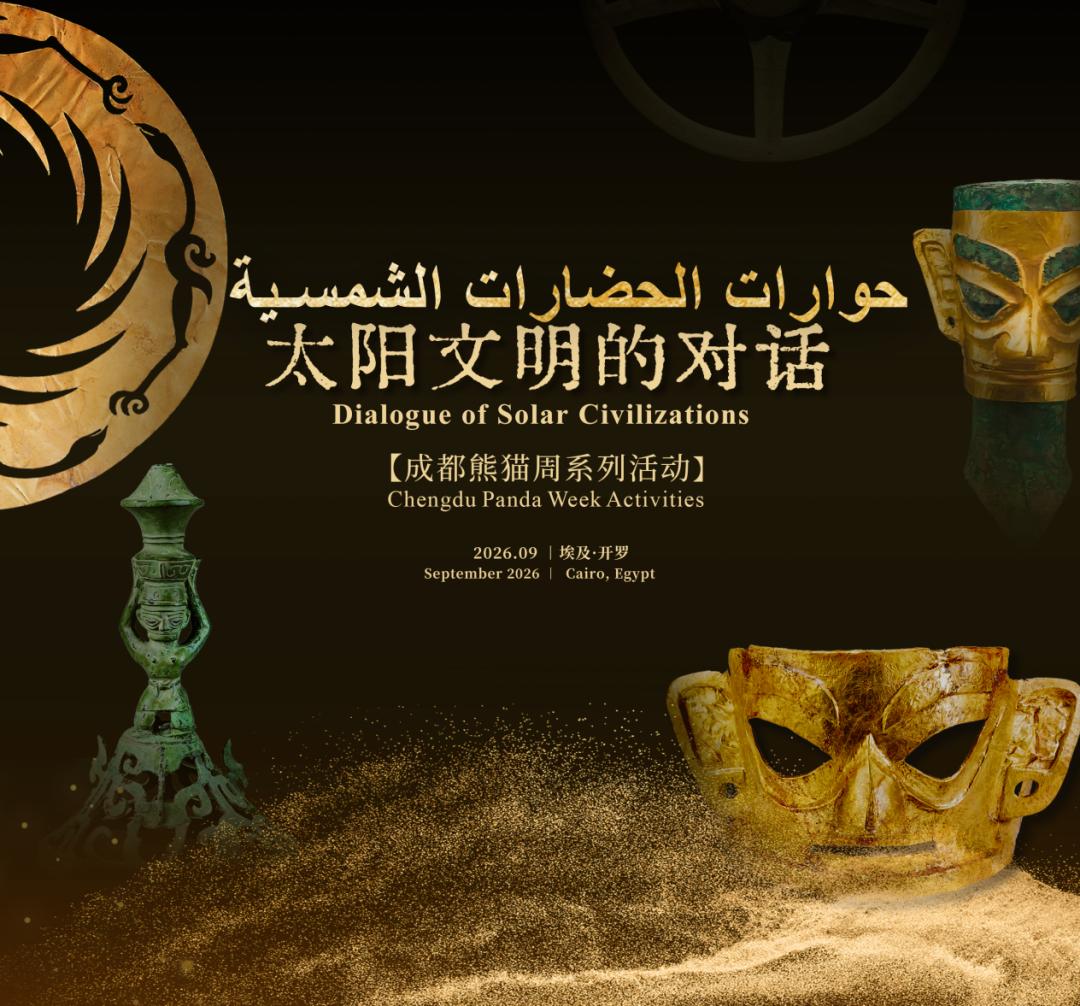
Located in the Chengdu Plain in the western part of the Sichuan Basin,“Sanxingdui and Jinsha Sites”(1600~800BCE)comprises two component parts-the Ruins of Sanxingdui City and the Core Area of Jinsha Site, together they formed an archaeological complex that was built by the ancient Shu people, featured by their distinct social stratification and unique belief system.The area has a dense network of waterways and vast expanses of farmland, and connects to the spectacular Longmen Mountain Range on the Qinghai-Tibet Plateau,offering a striking example of harmonious coexistence between humanity and nature.
Learn moreFollow us
Learn moreVoices
Learn more